
Late Light at the Grand Canyon
Some places don't feel real until you're standing there.
The Grand Canyon is one of them.
You've seen photographs. You know it's large. You arrive expecting to be impressed. And then you walk to the edge and look out, and something unexpected happens, your brain genuinely struggles to process what it's seeing. Not because the view is confusing, but because the scale is simply beyond what human experience normally prepares you for.
It is one of the few places on earth that makes you feel both very small and very lucky to be alive at the same time.
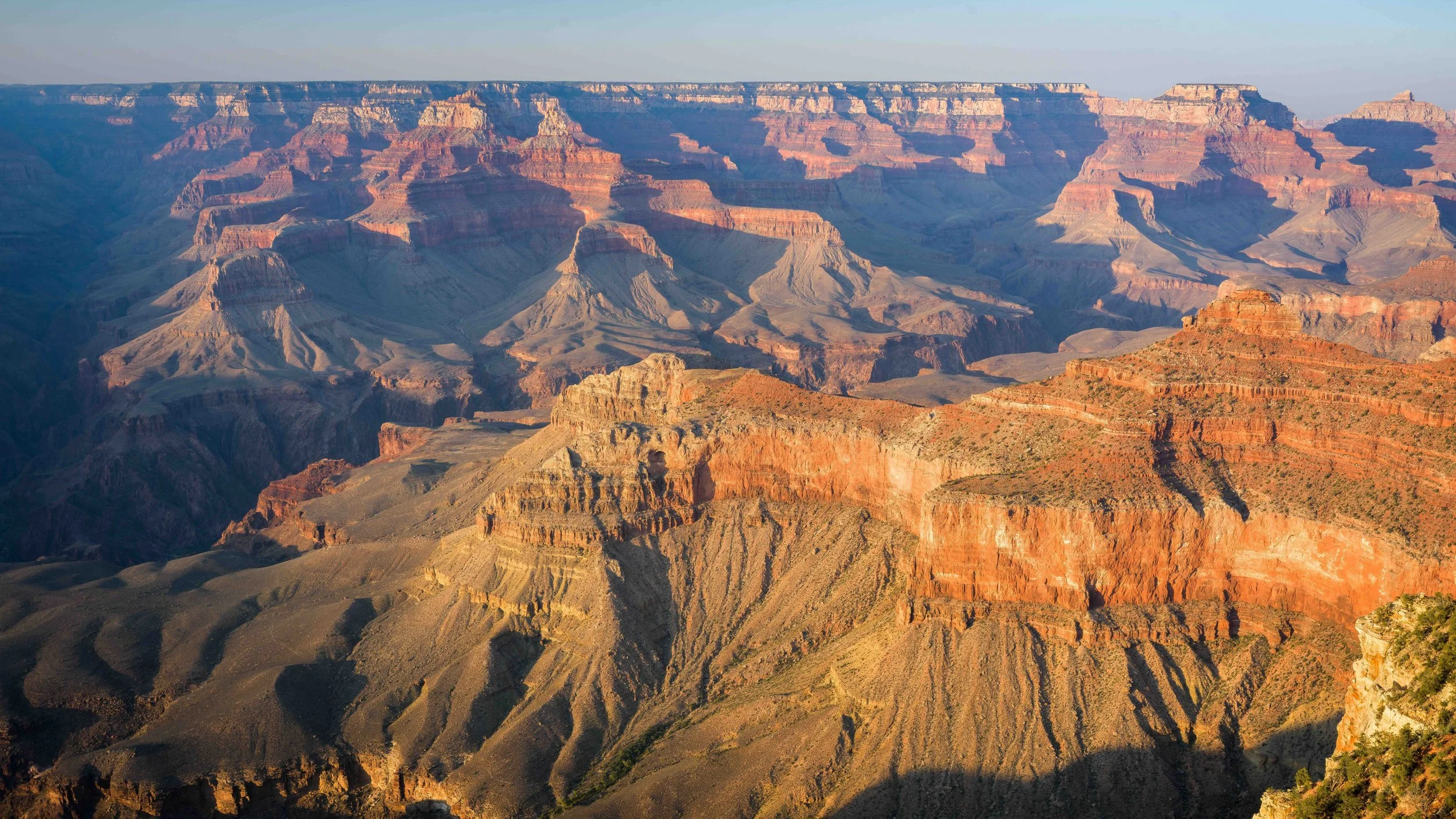
Mather Point: Where Most Journeys Begin
This image was taken from Mather Point, the first major viewpoint most visitors reach after arriving at the South Rim. It sits just a short walk from the visitor centre, with no long trail required and no extreme conditions to navigate.
And yet what greets you there is one of the most visually complex landscapes on the planet.
There's something quietly ironic about that. One of the world's great natural wonders, accessible to almost anyone willing to make the journey. The viewpoint can be busy; other visitors, other photographers, all drawn to the same edge for the same reason. But there's a particular kind of unspoken respect that exists in those moments. Everyone there knows what they're looking at, and that shared understanding tends to bring out the best in people.
A Place Written in Stone
The Grand Canyon stretches approximately 277 miles in length, reaches nearly 18 miles across at its widest point, and drops more than a mile from the rim to the canyon floor. The Colorado River carved it over the course of millions of years, cutting steadily downward through layer after layer of ancient rock.
What you're looking at, standing at the rim, is close to two billion years of geological history laid out in horizontal bands of colour. Each layer a different era, a different world. The pale limestone at the top is around 270 million years old. The dark rock visible near the canyon floor dates back nearly 1.7 billion years.
That is not a number the human mind handles easily. But you feel something of it, standing there. A sense of deep time. Of a world that existed long before anything we've built, and will exist long after.
The Grand Canyon became a National Park in 1919, and a UNESCO World Heritage Site in 1979. Roughly six million people visit each year. And still, when you arrive at the rim, it finds a way to surprise you.
When the Light Moves
This photograph was taken in the late afternoon, as the sun dropped low toward the western horizon.
That timing matters enormously here.
As the light descends, it begins to move across the canyon in layers. The ridges catch it first — warm, amber, almost glowing. The deeper valleys fall into shadow. The result is a natural contrast that gives the scene a sense of structure and depth that no artificial light could ever replicate.
The canyon reveals itself in stages, almost as if it's deciding what to show you.
I waited for the moment when light and shadow were working together rather than competing. When the foreground felt anchored and warm, and the layers behind it receded gradually into cooler blues and purples. The pale sky above held everything in place without drawing attention to itself.
There was nothing to force here. The landscape already had everything it needed.
What the Image Holds
What makes this image stay with you is not just the scale, it's the detail within that scale.
Every ridge, every colour shift, every layer of exposed rock carries part of a story that stretches back further than the mind can comfortably reach. The image rewards a second look. And a third. Each time, something else resolves itself — another shadow, another edge, another shift in tone that wasn't visible at first.
It feels vast. But also extraordinarily precise.
That combination is rare. And it's why the Grand Canyon, despite being one of the most photographed places on earth, never quite looks the same twice.
Layered Canyon is available as a fine art print on paper, metal, and acrylic. This is an image that genuinely benefits from size. The larger the format, the more the detail reveals itself, and the more the viewer is drawn in. If the canyon has stayed with you, this print brings something of that feeling into your space.