
Dusk at Mather Point
There is a moment at the Grand Canyon that most people miss.
Not because they leave too early, though some do. But because after the sun has dropped and the obvious colour has faded, the eye tends to stop looking. The show, in the traditional sense, feels like it is over.
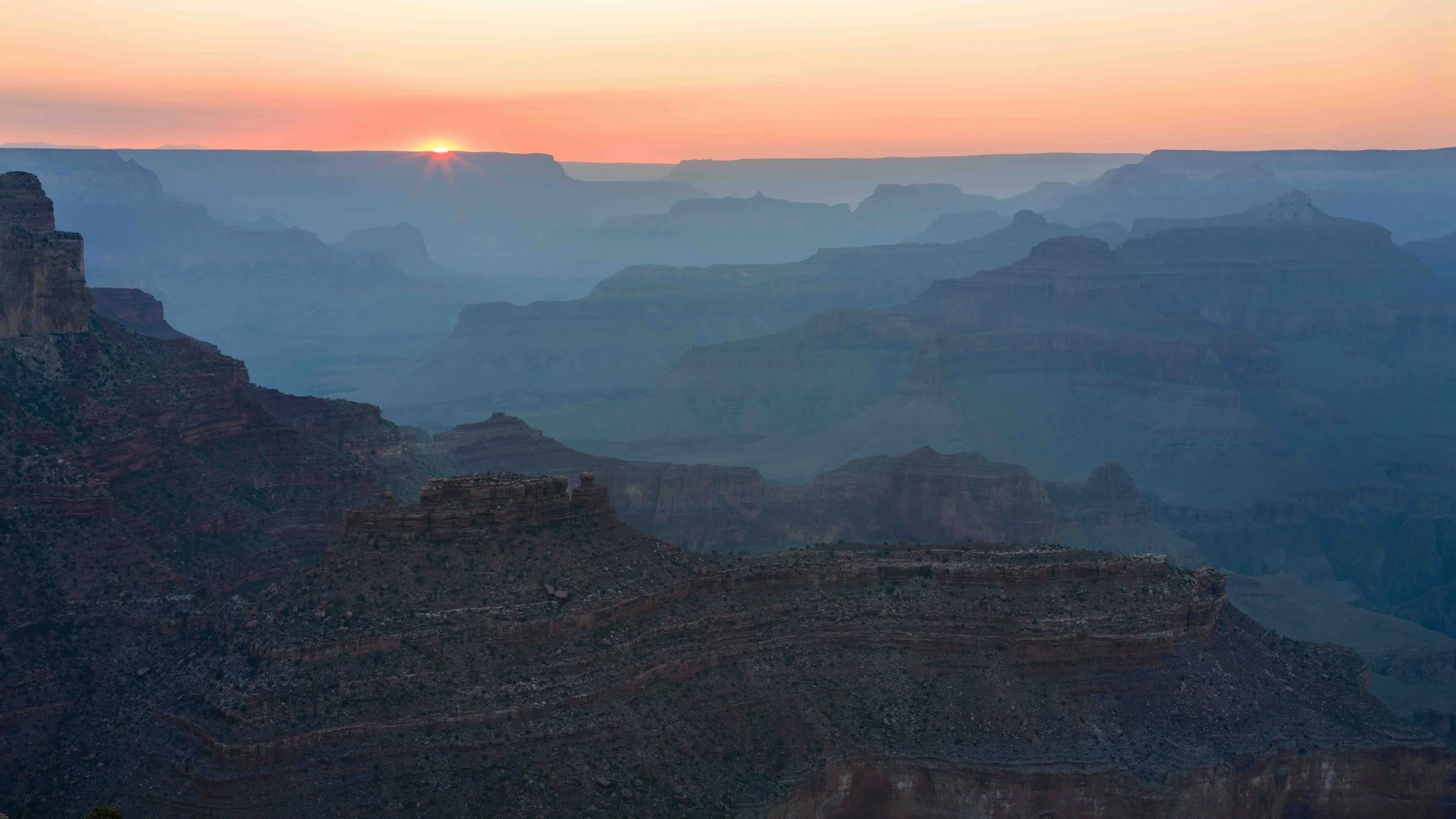
That is exactly when I made this image.
Staying Longer Than I Planned
I had been at Mather Point for several hours by this point. If you have read my earlier post from this same visit, you will know what the afternoon looked like. Warm. Detailed. Direct light touching every surface of the canyon walls with that particular flatness that makes the colours feel almost too good to be true.
But I stayed longer than I intended.
As the sun moved toward the horizon, the canyon started to look different. Softer. Less about individual features and more about layers, about mood. And I found myself not wanting to leave.
The crowds were still there. Photographers scattered along the rim, each trying to find their angle in the fading light. There is a quiet solidarity in those situations. An unspoken understanding between strangers who are all there for the same reason.
Then the sun touched the horizon. Dipped below it.
And instead of packing up, I stayed.
What the Canyon Becomes After Dark
What happened in those final minutes was something I had not fully anticipated.
The hard edges softened. The warm reds and tans that define the canyon in direct sunlight gave way to something cooler, more layered. Blues settled into the valleys. The ridges became silhouettes rather than features. The haze that sits in the canyon throughout the day suddenly had colour of its own, a soft, almost luminous grey-blue that stretched across the entire depth of the scene.
And right at the horizon, barely there now, the last point of the sun. Not blazing. Just quietly going.
It was not dramatic in the way Grand Canyon sunsets are often described. There was no explosion of colour, no single moment where everything turned gold. It was something quieter and, I think, rarer. The canyon shifting from one version of itself into another. The pause between day and dark.
The Case for Restraint
There is a tendency with a landscape this large to chase the peak moment. The sharpest light, the strongest colour, the most obvious drama.
This image comes from a different instinct.
Parts of the canyon fall into shadow here. Details that were clear an hour earlier have disappeared entirely. The viewer is left to fill in what is not shown, and in doing so, they become part of the image rather than simply observers of it.
I have come to believe that the most lasting images are often the ones that hold something back. That leave space. That do not try to contain everything, because some things cannot be contained. The Grand Canyon is one of them.
What this image tries to capture instead is a feeling. The feeling of being somewhere remarkable and having the good sense to stay a little longer than you planned.
A Different Kind of Grand Canyon Image
Most Grand Canyon photography leans into scale and warmth. The canyon walls glowing amber, the sweeping panoramas, the golden hour drama.
This image goes somewhere else entirely. The palette here is cool and restrained. Blue-grey silhouettes recede into the distance in layers. A thin band of warm sky at the horizon is the only reminder that the sun was right there, moments ago.
It suits someone who has stood at that rim themselves and knows that the quieter version of it is sometimes the one that stays with you the longest.
Sunset Canyon is available as a fine art print on paper, metal, and acrylic. This is an image for still spaces. A bedroom, a reading room, a hallway where people slow down without quite meaning to. It does not demand attention. It rewards patience.