
A Grey Afternoon in Glencoe
Some places feel like they belong to another time.
Glencoe is one of them.
I have a particular relationship with the Scottish Highlands. I grew up in Scotland, and the landscape there is part of how I understand the world. The weight of the sky. The way light moves through cloud cover rather than breaking through it. The green that is unlike any green I have seen anywhere else on earth.
Coming back to photograph it always means something different from going somewhere new.
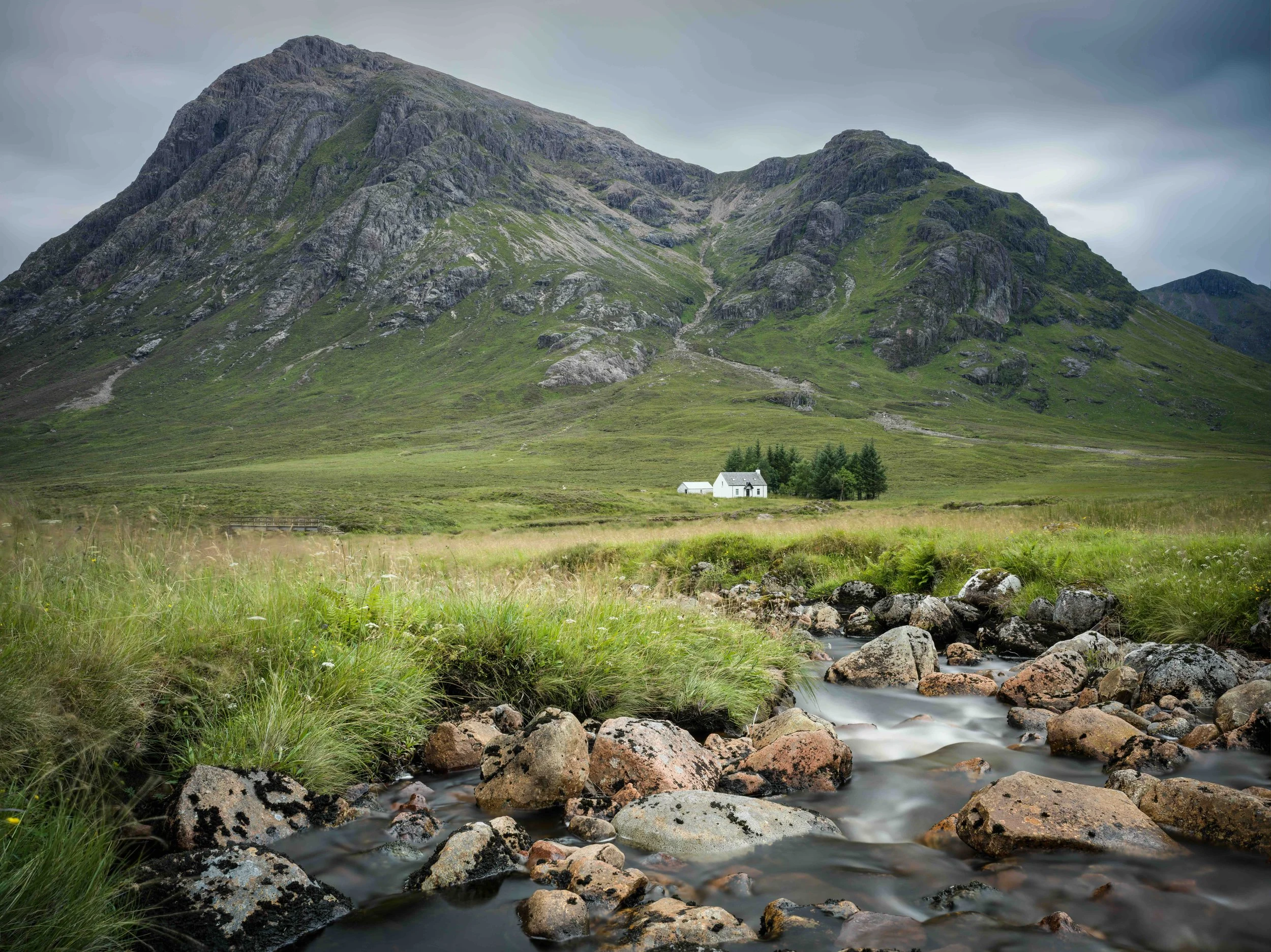
The Great Herdsman
This image was made beneath Buachaille Etive Mòr, which translates from Scottish Gaelic as The Great Herdsman of Etive. It stands at the junction of two glens, Glen Etive and Glencoe, and has been a landmark for travelers through the western Highlands for centuries. That distinctive pyramid shape is almost impossible to mistake.
It has also been photographed thousands of times. That is simply the reality of working at a location like this. Every serious landscape photographer who passes through the Highlands eventually points a camera at it.
So the question is never whether to photograph it. The question is how to find your version of it.
What Scotland Actually Looks Like
On this particular afternoon in July, the light never broke through. No dramatic rays cutting across the valley floor, no golden glow on the ridges. Just a heavy sky pressing down on the landscape and that soft, diffused light that comes when the cloud sits low.
And honestly, that is not a disappointment when you are in Scotland. That is Scotland.
There is a temptation, particularly when you have traveled somewhere to photograph it, to wait for conditions that feel more cooperative. The dramatic light. The clear sky. The moment where everything comes together the way you imagined it on the drive up.
But sometimes what the landscape is giving you is already the truth of it. The honest thing is to work with that rather than against it.
The Cottage at the Mountain's Foot
The small white building sitting at the base of the mountain is Lagangarbh Hut, a historic mountaineering cottage owned by the Scottish Mountaineering Club. It has been there since 1927. Climbers and walkers have used it as a base for approaching Buachaille Etive Mòr for nearly a hundred years.
When I moved lower to bring the stream into the foreground, the cottage came into frame almost by itself. And that single element changed everything.
Without it, you have a large mountain and a wide green valley. Beautiful, but abstract. The moment the cottage enters the picture, you have scale. You have the suggestion of a life being lived within that vastness. A fire perhaps. Someone inside looking out at the same mountain I was looking at.
It makes the landscape feel both enormous and quietly human at the same time.
The stream in the foreground adds movement and draws the eye through the scene naturally. The rough stone around it contrasts with the soft flow of the water. And behind everything, the mountain holds its position. Unhurried. Unmoved.
A Place Worth Knowing
Glencoe carries more history than most valleys.
In February 1692, it was the site of one of the most notorious events in Scottish history, when members of the MacDonald clan were killed by government troops who had been received as their guests. The Massacre of Glencoe left a wound in Scottish memory that has never fully healed.
Walking through the valley in midsummer, the green slopes bright and the river running cold, it is hard to hold that history and the present beauty of the place at the same time. But they both belong there. The landscape absorbed what happened in it and kept going.
That is part of what gives Glencoe its particular feeling. Something that is difficult to name but impossible to miss.
Cottage of the Mor is available as a fine art print on paper, metal, and acrylic. The muted greens, soft greys, and earthy tones of the Highland landscape sit naturally in almost any interior. It is a grounding image. Something that brings atmosphere and depth into a space without asking for too much in return. For anyone with a connection to Scotland, it tends to stop people mid-step.