
There's something about still water at sunset that makes everything slow down.
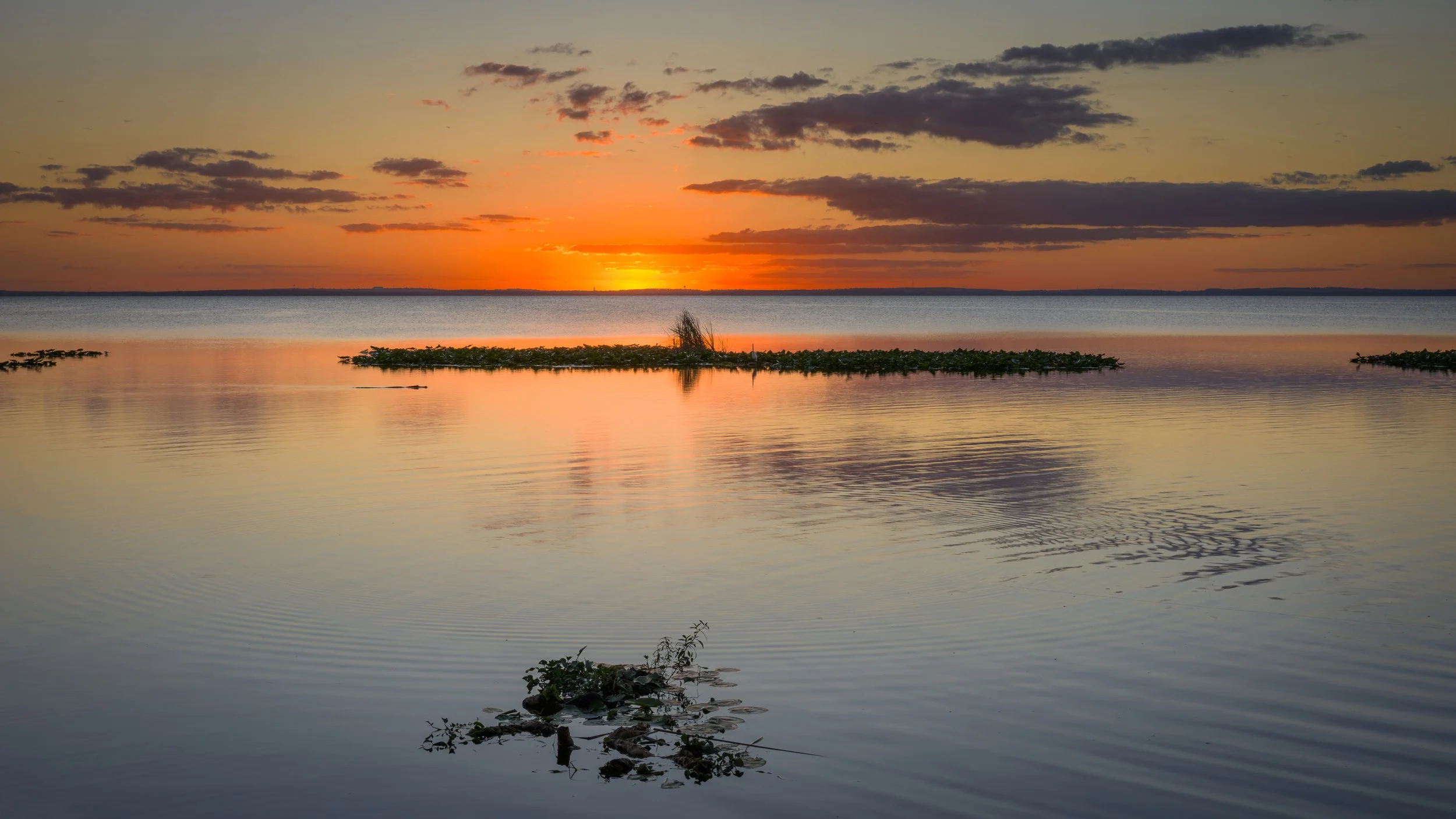
This photograph was taken on a quiet September evening at Lake Apopka, one of central Florida's largest and most quietly beautiful lakes. I wasn't chasing anything dramatic that night. No storm on the horizon, no golden hour spectacle. Just a low horizon, a soft sky, and the kind of stillness that asks you to stop and pay attention.
At first glance, the scene is deceptively simple — a wide, calm stretch of water, the last warmth of the day fading across the surface, a few whispers of movement in the foreground. Nothing particularly demanding of your attention.
But sometimes the quietest images carry the most.
Lake Apopka: Central Florida's Quiet Giant
At roughly 31 square miles, Lake Apopka is the fourth largest lake in Florida and one of the most ecologically significant in the state. For much of the twentieth century it struggled — polluted by agricultural runoff and a major pesticide spill that left its waters clouded and its wildlife depleted. But over the past few decades, sustained restoration efforts have gradually brought the lake back to life.
Today, Lake Apopka is a genuine haven for wildlife. Herons, egrets, anhingas, roseate spoonbills, and ospreys are a common sight along its banks. Alligators move through the shallows with the easy authority of something that has always belonged there. The Lake Apopka Wildlife Drive, which runs along the lake's northern shore, is considered one of the best birding locations in the southeastern United States.
It is, in short, a place that rewards patience. And that quality comes through in the light.
Being There
Lake Apopka has a particular quality of light in the late evening — soft, unhurried, almost amber in tone. The air carries the smell of warm water and cypress. There's a low hum of wildlife settling in for the night.
I wanted the image to hold some of that atmosphere. To keep the water feeling genuinely quiet rather than frozen. The exposure was long enough to let the surface soften, but not so long that it lost its sense of presence. The scene needed to feel real — not manipulated, not perfected. Just honest.
That philosophy runs through everything I make. The goal is always for an image to feel like a place you could step into, not a place that's been made to look better than it was.
The Detail That Changed Everything
It wasn't until I was back home, sitting with the image, that I noticed it.
A Florida alligator, moving silently across the far edge of the frame. Unhurried. Unannounced. Completely at ease in a scene that had appeared, on the surface, to be perfectly still.
That one detail shifted everything for me. This wasn't just a landscape anymore. It was a reminder that stillness is rarely as complete as it seems — that life continues, quietly and on its own terms, whether we're watching for it or not.
It's a thought that stayed with me long after that evening.
Why This Image Resonates
Stillwater Sunset isn't a complicated photograph. And that's precisely why it matters to me.
It represents something that's easy to lose in the noise of daily life — the willingness to slow down, to stay with a moment, and to let things reveal themselves gradually. The alligator wasn't a planned element. It was a reward for patience.
Stillwater Sunset is available as a fine art print on metal and acrylic — each format chosen to honour the subtle tones of the image, from the soft gradients of the sky to the quiet movement across the water's surface. If you've ever stood at the edge of a lake at the end of a long day and felt the world settle around you, this image was made for a wall in your home.