
Steam Across Glenfinnan
Some places feel like they belong to a film.
Glenfinnan is one of them.
Even if you have never been here, there is a good chance you recognise it. The sweeping curve of the viaduct, a steam train rolling across it, the Highlands stretching out in every direction. It feels familiar before you have even arrived, which is a strange thing to experience standing in front of a place for the first time.
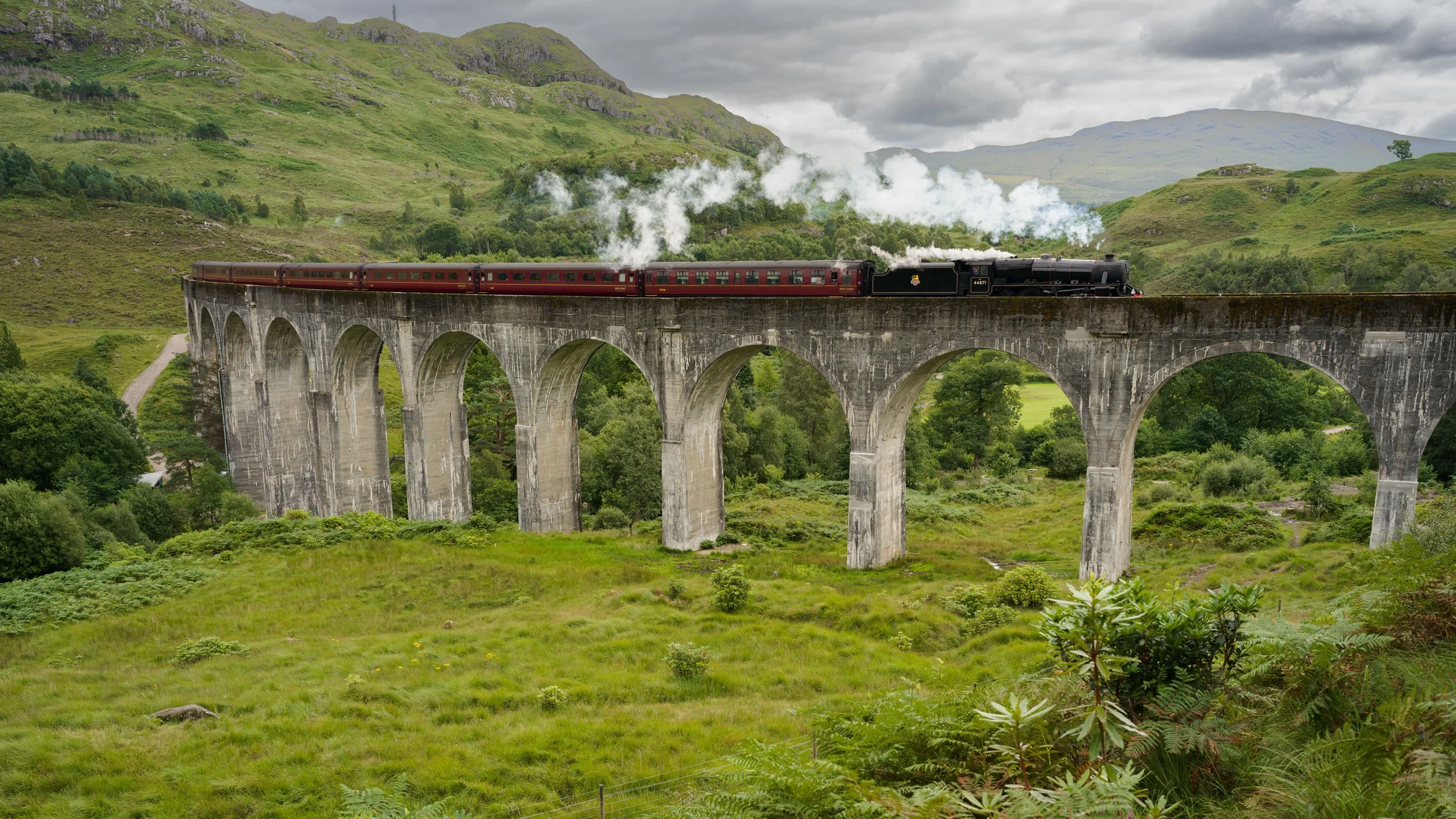
An Engineering Achievement First
The Glenfinnan Viaduct opened in 1901, built to carry the West Highland Railway across the valley on its route to Mallaig. It was designed by Robert McAlpine, who became known as Concrete Bob for his pioneering use of mass concrete in railway construction, at a time when most viaducts of this scale were still being built from stone or steel.
It remains one of the longest concrete viaducts in Scotland, with twenty-one arches curving gracefully through the glen. Over a century later, it is still in active use, still carrying trains across the same arches McAlpine designed.
That alone would make it worth photographing. But Glenfinnan has become something more than an engineering landmark over the years.
Where Fiction Meets the Landscape
The Jacobite Steam Train, which runs along this route in the summer months, has become informally known to many as the Hogwarts Express, after appearing in several Harry Potter films crossing this exact viaduct. For a generation of visitors, that association is the reason they come.
It is an interesting thing, watching a place absorb a piece of fiction into its identity. The viaduct existed for over a century before any of that. It will exist long after. But for now, those two stories sit together here, the genuine history and the borrowed one, and somehow neither cancels the other out.
What You Don't See
From this angle, the scene looks peaceful. Almost untouched.
It is not.
Just outside the frame, there are hundreds of people. On a busy day, easily three or four hundred, spread across the hillside on both sides of the valley. Tripods. Cameras. Phones held up in every direction. Everyone there for the same reason, all waiting for the same brief window when the train appears around the curve.
And somehow, when it finally comes through, all of that falls away. For the few seconds it takes the train to cross, it feels like you are the only one there.
Timing the Shot
Capturing the train mid-crossing meant working with a faster shutter than I normally use. I wanted the motion frozen cleanly, the detail preserved in both the train and the landscape behind it, rather than letting anything blur into abstraction.
The steam was the variable I could not control. It moves with the wind, thickens and thins unpredictably, and on this particular crossing it rose in long, full plumes against the green hillside behind it. That was the moment worth waiting for. A few seconds earlier or later, and the steam would have sat differently in the frame entirely.
Why This Image Works
There is a natural rhythm in the composition. The arches of the viaduct lead the eye steadily across the frame, drawing it directly to the train. The hills behind ground the whole scene in the landscape it actually belongs to.
And then there is the steam itself. It adds movement, life, and just enough drama to lift the image beyond a static landscape shot. The scale of the viaduct against those vast hills does the rest.
Part of what makes Glenfinnan worth returning to is that it carries more than one story at once. There is the engineering history, McAlpine's concrete arches still standing strong after more than a century. There is the deeper Highland history of the glen itself, with its own ties to the Jacobite cause the railway later took its name from. And there is the newer layer, the cultural one, that brought an entirely different audience to this valley.
It is rare for a landscape to hold that many threads at once and still feel, when you are standing in it, like a quiet, ordinary glen in the Scottish Highlands.
Crossing Glenfinnan is available as a fine art print on paper, metal, and acrylic. It is a piece that naturally draws the eye. Dynamic, recognizable, full of movement and character, it works particularly well in spaces where you want energy on the wall alongside genuine atmosphere.