
Fog and Stone at Neist Point
Some places feel like the edge of the world.
Neist Point is one of them.
On the northwest coast of the Isle of Skye, the land does not gently fade into the sea. It drops. Sharp cliffs, dark rock streaked with green, and the open Atlantic stretching out beyond the horizon with nothing else in the way.
At the very end of it, a small lighthouse stands quietly, doing the same job it has done for over a century.
When Plans Don't Go Your Way
This was meant to be an early morning shoot. The kind where soft light wraps around the cliffs and everything feels clean and clear.
Instead, it was rain. Thick cloud. Fog so dense in places that I could barely see the path in front of me, let alone the lighthouse I had come to photograph.
Classic Skye.
For hours, there was genuinely nothing to shoot. I sat in the car for a while. Walked the headland anyway, more out of stubbornness than expectation. Skye has taught me, over several visits, that the weather here does not negotiate. You either wait it out or you go home.
So I waited.
A Brief Opening
Around midday, the fog began to lift.
Not completely. Not the dramatic clearing you might hope for. Just enough.
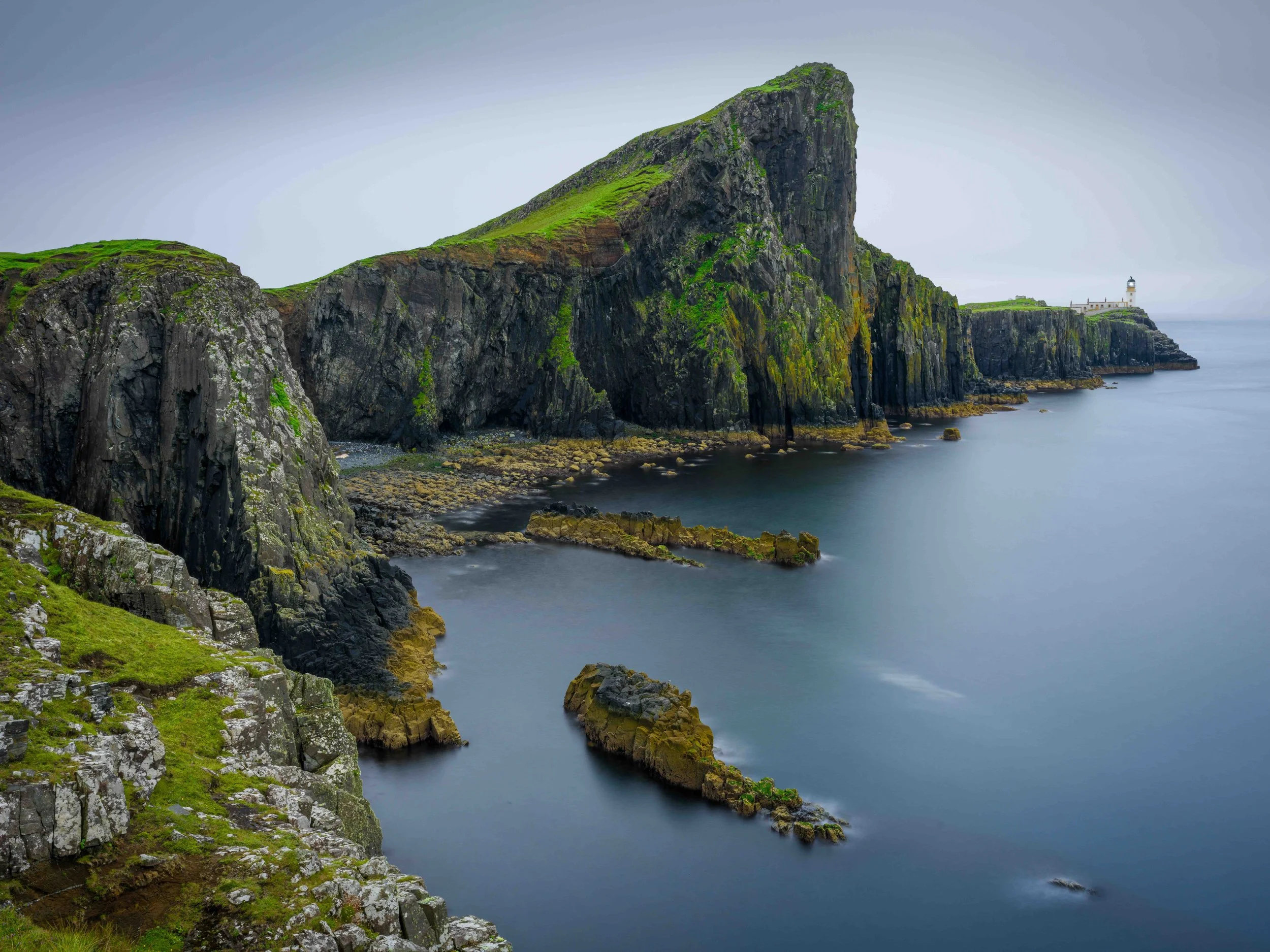
The cliffs revealed themselves first, dark and textured, the green moss along their edges suddenly visible again. Then the lighthouse came into view in the distance, sitting at the end of that long, dramatic stretch of coastline. The window lasted long enough to set up, compose, and get the shot.
Then it closed again, and the fog rolled back in as if it had never left.
That is the nature of working in a place like this. You do not get to choose your moment. You simply need to be ready when one arrives, however briefly.
Neist Point Lighthouse
The lighthouse at Neist Point was built in 1909, designed by David Alan Stevenson, a member of the same family of engineers responsible for many of Scotland's lighthouses, including the Bell Rock and Skerryvore. It was constructed to guide ships safely past one of the most exposed and treacherous stretches of coastline in the Hebrides.
It operated with a resident keeper until it was automated in 1990, and it remains an active aid to navigation today, marking the westernmost point of Skye for vessels passing through the Sea of the Hebrides.
The walk out to it, along the cliff path from the car park, is one of the most well known routes on the island, and on a clear day, the view stretches across to the Outer Hebrides. On a day like the one I had, you are lucky to see the lighthouse at all.
Shaping the Scene
A long exposure smoothed the movement of the ocean into something calm and almost glass-like. The cliffs stayed sharp, textured, exactly as rugged as they actually are. The water, by contrast, settled into something still and quiet.
That contrast is what holds the image together. The land feels permanent. The sea feels endless. And the lighthouse sits at the point where the two meet, small against all of it, but holding its ground.
There is a natural leading line through the whole composition too. The curve of the cliffs, the texture of the moss, the line of rock all draw the eye toward that lighthouse in the distance. It looks intentional. It was entirely shaped by the land itself.
Why This Image Works
There is a balance here between drama and calm. The landscape is rugged and powerful, exactly what you would expect from Skye's most exposed coastline. But the long exposure introduces a stillness that softens the whole scene, without taking away any of its power.
It is the kind of image that rewards the wait it took to get it.
Lighthouse on Neist is available as a fine art print on paper, metal, and acrylic. The rich greens, dark stone, and moody atmosphere make it a strong statement piece, the kind that holds a room's attention without needing bright color to do it.